Tom Bray's postings of the various interesting projects he works on at the University of Michigan. I started it to help my new colleagues at the Library better understand what I do.
Here are a few shots taken on a very snowy Saturday afternoon in late December when four of us went up to the transmitter to have a photo taken for the Ann Arbor Observer.
The bad news is that because testing of the new transmitter proved beyond a doubt that we would totally disrupt a lot of labs near this site, we will never be able to use this lovely new structure. We have started the process of finding a new site for our 3000 watt transmitter, more on the west side of central campus.
Even so, here's what it all looks like after the fine job Jim Campbell did organizing this project.
The gang on the roof for our photo shoot for the Ann Arbor Observer. Tom Bray, Jim Campbell, Liz Wason, Ben Yee.
This is me trying to recreate the shot of Floyd Miller in a similar pose with our old antenna.
Here is a stitched image of the whole antenna tower structure. You can see the
I-beams added to the roof to support the whole thing.
The two weird shapes on the left are protective covers for the actual antenna elements of our new antenna array.
This is looking up the new tower. On the right you can see our old 200 watt antenna sticking out Still the one we are using.
Close up of the I-beams supporting the new tower.
Close up of an attachment point for the new guy wires.
This is how the guy wires are attached. It is a twist of wire rope over what is essentially a plastic cable. This ensures there is not electrical path between the guy wires and the building.
Let me get this out right up front: it was an amazing week. It's not often that one gets unfettered access to every part of Michigan Stadium as part of a crew setting up for a very expensive ($200K+) and highly anticipated part of the halftime show of what was being billed as THE college football game of, well, pretty much all time. According to the UM Athletic Dept., at least. This was the last time UM was going to play Notre Dame, maybe forever.
My role was to be the UM liaison part of the laser team as needed, to document the process & event, and to be useful where I could. This is the kind of production event where, despite all the planning, on-the-spot thinking and coordination is expected. I have a great deal of experience with live event/theater/media production so this was a natural fit for me.
NOTE my "M" arm sling; this was 2 weeks after a serious shoulder injury.
The planning started in the Spring, and Sunday Sept. 1 found crews from Texas, California and Ann Arbor working with UM staff to get all the gear moved into position, set up and coordinated with the band rehearsals to turn this all into a halftime show at Michigan Stadium.
The loudest reaction in the halftime show was when they turned off ALL the stadium lights.
Not only has this has never happened before, it's never even been asked about before. It was not a surprise that many people were reluctant to allow all the lights to be turned off. In the end, they agreed that the Jumbotron displays at each end of the stadium would provide enough light to keep everyone safe. It was approved with the bright white screens that were at the start of the show. It got quite a bit darker when the light level dropped when the screens starting showing live video from the field.
The second loudest reaction was for the laser image of the dancer in the end zones.
I'm particularly proud of that because of the role of the DMC. I captured a member of the dance team in the video studio, pulled out sections of specific moves and processed them to provide a movie used to create the outline needed to generate the vector file used by the laser software to "write" the image of the dancer in the end zones. At the time, it as noted that this (and the DMC) was the only part of the operation that was actually on schedule.
A lack of timely information kept making things harder as we went along, but the talent, professionalism and dedication of the laser/lighting teams insured that in the end it all worked. It was clear that this was no one's first rodeo.
The plan had a number of vans with lasers circling the exterior of the stadium: 2 vans with a laser painting the back side of each Jumbotron (scoreboard) with text and images; 3 vans with lasers painting around the crown of Crisler Arena with text and images; 1 laser on the photo deck on the top floor of the press box doing the scrolling text on the top row of panels on the skybox side opposite, 2 lasers under each Jumbotron painting the inside (display) surface of the opposite scoreboard and 2 lasers (one each) on the roof of each tower creating the images on the field.
Bo on the back of the North end scoreboard.
I need to be clear here: these were very powerful lasers: safety was our overriding concern. These were not "laser pointer" lasers. They were more like "No Mr. Bond, I expect you to die!" lasers. Any laser requiring 2 or more digits defining its output is dangerous.
Ann Arbor folks were running the lasers in several of the vans. I took my turn running the scrolling text in the stadium when I wasn't shooting video of the process, and overall it was an experience that I will never forget. It had me interfacing with UM staff that I would not normally cross paths with, and I got a chance to say hello to some of the TEL Systems staff (Mario & Chris) that are always there on game days standing by or acting as the stadium audio engineer. Wilm Pierson, the son of a local lighting and production contractor that I've known for 30 years, was the designer and operator for the Synchrotron moving lights.
The synchrolites could be seen for miles...
...but getting them on the roof was "non-trivial".
It was great to see how Athletics does things compared to other units I've worked with on campus. Resources do make a difference.
OK, here are some links. More details and more video and photos follow.
It is not often that one gets to truly see one's self through someone else's eyes.
In this case, I like the person she evokes.
Other than that, I'll just let this speak for itself.
========================================================================
Georgia Hampton
11/22/13
ARTDES 150
John Gutosky
Documentary Photography Assignment
I’ve taken a course about photojournalism in the past, and for that reason I probably shouldn’t be as anxious about approaching strangers in order to photograph them as I am. So, for this very quick assignment, I was frustrated with myself for being so uncertain when I initially went out to find someone to photograph. I kept coming up with excuses not to ask someone walking by.
Then, however, I saw this man giving a lecture to a group of students in the 3D lab at the Duderstadt; he was wearing flip-up glasses (the kind that older people wear) but instead of normal glasses they were 3D glasses. Immediately I forced myself to get over my inhibitions because you just don’t see glasses that outrageous every day.
Thomas Bray, the man with the silly glasses, is what his business card describes as a “converging technologies consultant.” In basic terms, that means that if you want to convey a certain emotion in your video exhibition, need help navigating the 3D printer, or have an idea and have no idea what kind of technology to use to make it happen, Tom is the person you want to talk to.
When I first began talking to him I thanked him for putting up with me and my camera, to which he quickly responded that he didn’t feel this was something to “put up with” at all. He said that in his mind art is something incredibly important, and that he was glad that he could be a part of it. By the end of the conversation he asked me to send him the photos I took of him and any interview I had, which I’m glad to do (Hello Tom!). I talked to him for maybe ten minutes, and in those ten minutes his enthusiasm for art and for innovation was so palpable that I left the conversation feeling excited for no discernable reason.
While I was trying to find a way to get him to talk about how he is “different,” he actually brought that up himself. We were talking about the faculty and staff at the university and how most of them know a great deal about one specific subject. He added that many people at this university probably know infinitely more than he does about any given thing. What makes Tom unique, however, is his wide range of knowledge, whether it is in theater or engineering or numerous other fields. I find this quality to be extremely important in a university, especially a university like this one that encourages the melding of very different programs.
I hope there are more people like Tom Bray around Michigan who inspire people to create and explore.
I was part of the production team for the MCubed event on Friday November 15th.
"The Case For the Cube", as it was called, was akin to a mid-term book report on all the projects that had been "cubed" with this funding.
Overall it went very well, and all of us on the MCubed team were well pleased at the end of the day.
For the final presentation ("Jeweled Net...") of the afternoon sessions in the League, I brought in 2 extra projectors to expand the map generated of the dark matter in the universe. It looked very cool on the ceiling in Mendelssohn theater. You can see the onstage screen at the bottom of this video:
I enlisted some of the TedxUofM kids to help crew the presenter stations and provided some of the hardware used to streamline the presentations, laptops & timers, but mostly my role was to make sure that AV Squared, the production company providing the bulk of the AV gear, brought the right tools and was guided in how to work the event. I also worked at varying levels with two of the presenting groups: "Jeweled Net of the Vast Invisible" (singled out by Provost Martha Pollack as her very favorite title!) and "Opening the Music Archive: Community, Memory and Ethical Access".
"Jeweled Net" is a project to sonify and visualize the Dark Matter in the Universe, hence the "Vast Invisible" part. The team was Greg Tarle, an astrophysicist, Jim Cogswell, visual artist and Stephen Rush, musician.
"Opening the Music Archive" was Kelly Askew of the African Studies Center, Paul Conway of the School of Information, and David Wallace of SI. It's about getting audio assets out and available to people on line.
The MCubed team was planning to have the whole event in Lydia Mendelssohn Theater in the Michigan League, but when they suddenly had 1100 people register they decided to move the morning sessions to Rackham Auditorium - Mendelssohn only seats 640.
As it turned out they could have stayed in the League for the entire event because there were so many no-shows. The event organizers were stunned at the over 50% of those registered that did not show up for Tony Fadell's keynote address. Tony Fadell led the iPod development team, most of the iPhone development, and then went on to design the Nest series of home technology devices (currently a thermostat and smoke detector).
Here is a schematic drawing of the gear I provided for the presenters setup at both sites.
The top shows the location and content displayed for the three monitors at the front edge of the stage. This is 2 identical "confidence" monitors that mirror what is being projected, and one smaller monitor that displays the timer application being run on the iPad. Both the iPad and the 21 presenter laptops are on a table offstage, along with all the VGA switching and distribution gear. There is one cable bundle that ran across the front of the stage in this setup.
Why do we use VGA? Mostly because we have the gear to do it, but also because VGA still avoids issues like maximum distances in digital distribution.
Photos, first from Lydia Mendelssohn Theater in the Michigan League (check out the video clip later):
View of the stage from "Presentation Control". Note the monitors on the downstage lip of the stage.
View of the Command Center offstage right.
And from Rackham:
The TedX crew on site, along with Pat Murphy from Michigan Productions.
More TedX'ers, here to help escort presenters around the space and watch their stuff.
Tricia from AV2 at the wireless mic station at the back of the house in Rackham.
All the presenters were wired/unwired back here, away from the audience.
Me with CoE Dean Dave Munson (left) and Tony Fadell at Rackham.
It was gratifying to work with some old friends on their presentations, and apparently they also enjoyed it. Quoting Jim Cogswell:
Tom,
It is always a pleasure to work with you. You know what you're doing, I can trust you to operate at the highest standards of craft and creativity, and I learn so much each time. Thanks for shaping that presentation. Looking forward to my next chance to do something again.
jim
Jim Cogswell
Arthur F. Thurnau Professor and Professor of Art & Design
Penny W Stamps School of Art & Design
University of Michigan
I'll post links to other shots as they come available.
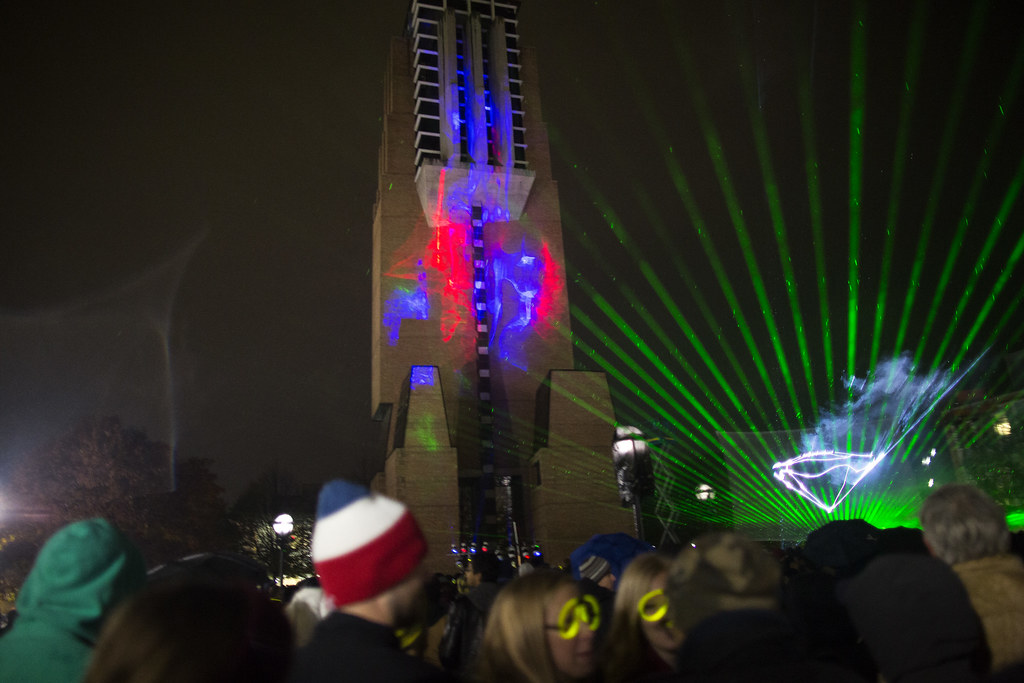
Once again, I was part of the laser team that brought fun expressions of columnated light to campus - and some of the photos below actually made the front cover of the University Record, both online and print!
This time it was on the North Campus Diag & Lurie Tower as part of the College of Engineering's localized campaign kickoff event. I worked with Holly Taylor & others at the CoE to help get things organized for the local Illuminatus team that did the Lumia lasers on Lurie Tower and the Daystar team from New York/California that brought in the big guns.
I also ended up handling the video projection part of the program, which was really no surprise; the laser guys were pretty busy, having lost a set up day/night due to bad weather and scheduling delays.
I had help in the form of someone holding an umbrella over me and the projector and the laptop screening the kickoff video.
Here are a few photos of the event and links to more. Stay tuned, as I will post a few more on this site when I get them.
-t
Overall view, with a good shot of the "Lumia" lasers on the tower.
They were passing out glasses made from glo-sticks which were, naturally, a big hit!
From a different angle.
A very recognizable block letter, eh?
The view from underneath the lasers, showing the screen for the video and then
line-drawing lasers, the scanning lasers, and the Lumia in the background.
Behind the scenes view from the laser position, during final setup.
The installation of our new transmitter and antenna has begun!
WCBN is soon going to be broadcasting at 3000 watts instead of our current 200 watts.
We hope to be on the air at 3000 watts by the end of November, if all goes well.
We are at the end of a long process that required FCC approval, engineering studies, coordinating with the UM AEC , the EEDRC, various UM Plant Dept. Units and external contractors and engineers.
In order to support a bigger antenna mast to hold our bigger antenna, the UM Plant Dept. engineered a way to add I-beam parts to the existing roof structure to create a solid base to which Great Lakes Tower company will attach our new antenna mast and antenna.
Today - Saturday Oct. 26, 2013 - the fine folks from the UM Plant Dept. carried a handful of I-Beam pieces (up to 400 lbs!) and antenna tower sections up to the very topmost roof of the Dennison building, where our antenna lives (photo below).
You can see a 360 panorama with Jim checking the antenna mast sections that I took on the roof. If you view it on an iPhone or iPad, click the little gyro icon in the bottom left corner of the screen and you can turn around and look up and down just as if you were there on the roof! Or you can just spin around and up & down with your fingers.
And DO NOT miss the chance to view it in a very fun way. At the top of the screen you will see 2 round buttons and one bowtie button. Click the round button on the right for a full bird's eye view!
If you just view it on a computer, you can only spin around in circles. Sorry.
And please forgive the "transporter accident" mis-alignments.
It was the best I could do in a cold and windy spot. With a cell phone.
Oh, and both in the photo below, the pano and some other shots, you can see our current antenna, which is on a simple pipe-like support mast. In the shot below, it is the one on the right.
Here on the roof are the I-beam parts that will be embedded in the roof to support the pieces of our new tower, whose 3 sections are also on the roof. The red circle is where the new antenna tower will sit.
Here are shots of most of the parts that will make up our new antenna array.
One of 2 sections that will support the actual antenna elements.
A close-up showing a TIG weld between brass and copper.
Close-up of the 'antenna tuners'.
The rods on the left slide in and out to fine-tune for a
specific FM frequency once the antenna is assembled.
One of the 2 actual antenna elements that create the pattern of our broadcast footprint.
The 2 elements are arranged one above the other on the antenna mast.
Their orientation with each other and the world determine our broadcast pattern and coverage.
Close-up of the "Phillystran" non-conductive guy wire that keep the antenna mast stable.
Our new tower will have 3 guy wires, just like our current one.
One of the 'connectors' that capture and hold the end of the guy wires at the rooftop attachment points.
It gets braided with the actual guy wire to form a very strong grip.
Finally, here's Jim Campbell with some shots of the parts of our new transmitter!
The parts that will go in the rack.
The 150 watt FM Exciter.
It's actually a low power transmitter that feeds
the input of the 3000 watt transmitter.
The 3000 watt transmitter!
It's designed thoughtfully: it has multiple power amp modules,
so if one fails all the others continue - although with a lesser power output.
The bad amp block can be replaced without turning off the transmitter, too!
This nicely edited version of the video from the shoot by Donald Harrison has just been posted on Vimeo.
======================================
Robert Marshall, a local geek and tinkerer, built this very large rotating geodesic Dome. He has taken it to several Maker Fares where it has been a great hit. When he had it in New York City, it was so popular he wore out 2 sets of the turntable it sits on!
People can get inside and get spun around, or just enjoy it from the exterior.
While not, strictly speaking, a UM gig, Amy Harris (Museum Director) and Matt Linke (Planetarium Director and long time DMC friend) were involved in making this happen. Matt is usually involved in anything physical that is out of the ordinary at the Museum, like the Dance events that I have been involved with.
This is from the evening of Sept. 15th when Robert, Donald Harrison, Amy Nesbitt and I set the Dome up in the rotunda of the UM Exhibit Museum (on N. University at the bus stops). We had one of Mike Gould's Lumia lasers (also used later on the North Campus) and some normal video lights.
When the finished video is posted I will add a link.
In the meantime enjoy these couple of clips from that night.
-t
(You can see these movies in HD on YouTube if you choose to do so.)
Final pieces are attached by Robert,
with assistant (Amy Nesbitt) and documentarian (Donald Harrison) in place.