Friday, 11 July 2014

2014 NMC Conference Report


The NMC Conference is the annual gathering of members of the New Media Consortium. NMC is the current instantiation of the New Media Centers, started in 1993 and in which UM was one of 10 founding Higher Ed institutions.  UM hosted the very first conference in Ann Arbor in 1994.


A few years ago they abandoned the long tradition of holding it at a member institution and went instead to being hosted by a member institution at a nearby conference hotel, usually with trips to the hosting campus for tours, etc.  


This year it was held June 17-20, 2014 in Portland Oregon at a downtown Hilton, with no tours.  This was because this conference was one day shorter than in the past, meaning fewer sessions of all kinds.


The day before the conference started, I went to the Portland Art Museum with one of the NMC Board members, Liz Neely.  She knew someone there from her work at the Art Institute of Chicago and had been invited to come see their new exhibit.  Turns out her assistant, Justin Meyer, is a PHD candidate in TCAUP and will be back around this Fall and Winter.  Small world.


What the exhibit was is a display they put at the very end of an exhibit on the Tuileries Gardens in Paris:


The idea was to get visitors thinking about the connections between this park in France and the parks around Portland.  They put together an Instagram campaign with the local Instagram community (yes, there is one in Portland)...


...and the Parks Dept. thought it was such a good idea they picked 12 parks and had cards printed for each one that visitors could take away.  That’s Liz on the right.


The large map on one wall showed those 12 locations…


... and a flat panel displayed the moderated web feed of submitted photos, mirroring what was on the web.


This has been a great success for them and they did it all for almost no money by partnering with the community and using open source tools.


Back at the conference, the first keynote speaker was Jason Ohler,  
   
    
known as a passionate promoter for “Art the Next R” and for his current book, “Digital Community, Digital Citizen”.  


His keynote considered five major technological trends that are just cresting and making their way into the educational arena: big data, augmented reality, the semantic web (comprised of Web 3 - The Internet of Data - and Web 4 - The Internet of Things), xTreme BYOD, and transmedia storytelling.  I’m hoping for a link to the video soon.


There were 4 Breakout Session opportunities, so I was able to go to 3 sessions other than my own.  Sessions I attended and have comments on were:


Gamify Learning Analytics: Using Color, Music, Shape,
and Movement to Promote Analysis of Data


With a name like this, of course I had to go.  Interesting approach to getting faculty to actually use the analytics that are available to them by turning them into visualizations that they can ‘play’, or that better show whether their strategies are actually mapping to their stated learning outcomes.


Audio Post-Production:
Unveiling the Black Art of Mastering
Raymond Riley ALMA COLLEGE


I had opes for this one to reveal some cool new way of wrangling audio for video that, but found it to be kind of a “how to make audio not sound bad for real beginners”. Nothing we don’t already know.  I was kind of surprised to see it on the program to begin with, and even more surprised after I found out the low level of the content.  I guess if you didn’t know any of this it would be useful, and there were a lot of people taking notes.  I guess I could think differently about what to present in the future, based on this.


Digital Strategy for a Generation
Nik Honeysett BALBOA PARK ONLINE COLLABORATIVE


Nik Honeysett has a long career, mostly involving museums, but always involving interesting thinking.  He has spent many years at the Getty Museum in L.A. and has just been appointed Exec. Director of the Balboa Park Collective.
His session synopsis:


“A three-year digital strategy is standard practice, the accepted norm . But every three years brings a disruptive technology: iPhone (2007), iPad (2010), Glass (2013). Institutions will survive for centuries, missions remain relevant for decades, so should a digital strategy. This presenter will argue for a 30-year digital strategy — a generation. Such a strategy would be forced to ignore technologies, focus on trends and identify core philosophies and practices to ensure ongoing institutional relevance and sustainability. What would such a digital strategy look like?”


Some notes from conversations around his talk:


“Interesting to think that today’s learner may actually be much more active than at first perceived. Their active involvement is in their very real world of the Internet: their creations are blobs, posts, texts. Their text is not a physical book but digital. Their minds are open to the world, but perhaps closed to what usually goes on in the classroom.”


I am trying to get a copy of his Prezi file for his presentation, because he raised so many interesting points:


“Digital Strategy - a self-sustaining framework to align staff and institutional decision-making with cultural and social trends.”


“What if we train people and they leave?  What if we don’t and they stay?”


“I’m so excited for my annual performance review today!….said no one, ever.”


My session, “Indiana Jones meets Generation Y”,
was on Thursday July 19th from 10:15 - 11:15 AM.  


Briefly, this session talked about the innovative digital resources used by Yaron Eliav in teaching “The Land of Israel/Palestine through the Ages”.  I got involved when the team needed to find a way to present virtual versions of actual relics from antiquity on the web, but it turns out Yaron had been building transformative resources for his class for many years, culminating in a huge Image Database that went live in Fall 2013 with geotagging and integration with Google Earth.  CRLT had done student surveying with the class in 2012, and I got Steve Lonn involved just in time to get some pre-class surveying done as the class was starting this past January and some post-class survey at the end of the term.


The edited session synopsis: “This session lays out the digital strategies that have brought the ancient world alive in a classroom-based course on the history and archaeology of the ancient Mediterranean. A University of Michigan team created and incorporated a GIS-tagged media database and 3D representations of 2,000 year-old objects into a preexisting online framework of digitized primary-source material and carefully targeted weekly homework questions.”


I had about 15 attendees who were very interested in the work and asked lots of questions.  Unfortunately I could not stick after my presentation as I had to leave for the airport to head to InfoComm.


I was originally to present with Dr. Justin Winger who has been working with Yaron for the last several years and with whom I worked for the virtual versions, but at the last minute he was unable to go. So I had to learn as much as I could about what he knew in very short order.  I think I did OK.
The Idea Lab, where the UM contingent won “People’s Choice” and “Judges Award” for the presentation on Matthew Barritt’s research findings around DL1, had some nice ideas again this year.  I wanted to highlight what I thought was a really innovative use of lots of current technologies:


Turning an electric wheelchair into a game console.


Learning how to operate an electric wheelchair is complicated and frustrating. Therefore, four student teams from Hogeschool Utrecht School of the Arts Utrecht and Eindhoven University of Technology have developed a game so children can learn to operate their electric wheelchair in a fun way.


They set up a “Game Jam” and over 48 hours the teams and kids had to come up with a game to help learn the basics: Forward, reverse, stopping at a certain place, and following a certain path.  Using augmented reality, sensors, and iPads original games were created to help the children improve their wheelchair skills.


Below is the poster Erik Mooij had at NMC, and a shot of how they used AR and an iPad. Students in the wheelchairs had the iPads mounted in front of them, and when they approached a target the iPad would show them the AR ‘prize’.  Having to approach the targets correctly and line up the right way used all of the skills they were trying to learn.


Finally, I talked with Larry Johnson, the CEO of NMC, about UM hosting another conference soon.  We will continue the discussions, but it would not be until 2017 at the earliest, more likely 2018.  Here’s a really bad shot of me, Larry and his wife at the opening reception:


Tom Bray


July, 2014

Thursday, 13 March 2014

2014: TEDxUofM

TEDxUofM

It has started...

Day 1

Here is a quick look at  of setting up, from first hanging lights to the first afternoon rehearsals.

And who's that guy in the red shirt down front...?


Day 2:


Setting up the passes in the lobby of Power Center in anticipation of attendees picking them up.


The other installations were also coming along.  The Electronic Lunch project masterminded by Conor Barry, the very cool live 3D modeling setup by Josh Williams (John's son), and a photo booth were mixed in with the artwork and hanging paint stir sticks.

Day 3 - the Show!

Since there are so many, I used smaller photos.

A little video of the audience filling the house...


Some shots of the lobby:

The hanging paint sticks.
The sticks with questions.
The swag table.
Some swag.
More swag.
Josh Williams' 3D scanning station.
He scans you against the wall, then you see the 3D
model right away via his projector.  Sweet...
(As soon as I get it, I will post the 3D model Josh made of me!)

Here it is!

The photo booth - "TED-ified".

Conor's lobby installation:


Passes still waiting to be picked up.
Jane and Mike, this year's co-chairs.
Rehearsing, seen through the set.
Tech table, mostly complete.
The "clicker" USB receivers are mounted on a
music stand on the left for better reception.
This is the schematic drawing of that cluttered table above.


Adam and Cole, our amazing PPT Wranglers.
Robert Alexander setting up his great data-driven synthesis system for his talk.
Kelsey talking with Vic Strecher at the tech table, pre-show.
A TEDx-er taking a shot backstage.
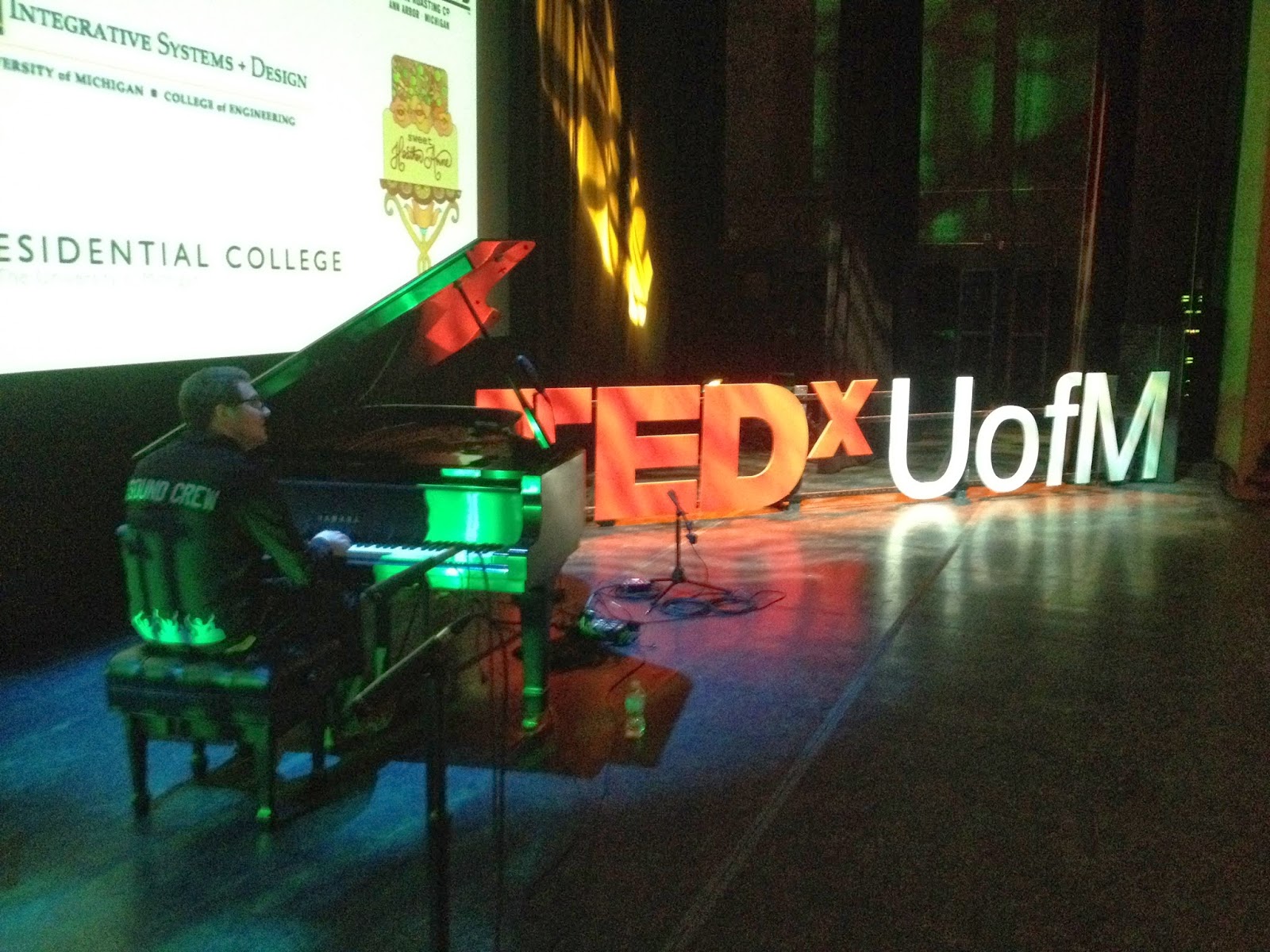
Tom from the sound crew testing the piano setup.

Travis behind the mixing console.
Cletus at the lighting board.
The Great Paper Airplane Launch!  
The programs included a printed sheet of paper with various markings.  
The creators of this model then came on stage and told everyone how to fold 
their very own paper airplane.  
Audience folding planes, as seen on TV!

Then on the count of 3, everyone launched at the same time!

My photo is a bit blurry, but you can see the lines of launching planes - it was great!
Anne Curzan on stage, on screen.  Great talk about - what else? - language.


Ever wonder what it's like to be on the Power Center stage?

Backstage, showing PowerPoint Central and the Video record table.
All the ropes behind them are the Fly Rail, used to bring pipes over the stage up and down.

Front and center, on the edge of the stage.
The tech tables above are off to the left, by the fly rail.

Now, enjoy this "Bird's Eye" view, then click on this link 
to go to a 360 panorama that you can spin around in!


This  year's TEDx was wonderful - smoothly produced, well thought out, and really, really fun!

Can't wait till next year!

-t

Friday, 31 January 2014

Two "Transforming Learning for a Third Century" Grants

UPDATE

Yaron Eliav got his grant, Bill DeYoung did not.  BIll is reworking his proposal and will apply for an internal grant at the SOMTD.

================
I am part of 2 grant proposals submitted to the UM's Teaching and Learning for the Third Century (TLTC) grant program.

The primary faculty member for the first one is Bill De Young of the Dance Dept.  He wants to produce an enhanced eBook that will help him teach dance students.  He is very good at many of the3 technical aspects of dancing, but he also has a lot to say about what he calls "The Path of the Dance Artist".   You can download a PDF of Bill's grant proposal here.

Here are a few shots of Bill and some student dancers during a test shoot at the end of the Fall 2013 term.  We shot this so we would have some footage to work with to determine how we might want to shoot the dancers for various parts of the eBook.  This footage lets us explore chromakey, motion tracking, and motion capture.

The motion capture system in front of the green screen.

Bill working with one of the dancers.

Another view as Bill works with the dancers.


The primary faculty member for the second one is Yaron Eliav of the Near Eastern Studies Dept.  He teaches the history of the ancient lands of Israel/Palestine and has come up with a very interesting way to better engage his students.

He has been working with LSA's LRC to set up a number of enhanced web resources, with highly tagged images,movies and readings.  I got involved when they were looking for a way to create virtual versions of objects at the Kelsey museum.  Students were going to be able to handle the actual objects but would need to be able to refer to them throughout the term for various assignments.

We ended up creating both Quicktime VR photo-based models as well as 3D versions using Autodesk 123DCatch, an free online app.

I have also proposed presenting this work at this year's New Media Consortium conference in June.   Dr. Justin Winger, also working with the project, would present with me.

A meeting at the end of the Fall 2013 term of the team working with Yaron.
Todd Austin of LSA-ISS talks to Arkady (from Russia) and Yaron
in the Duderstadt Center's video conference suite.
ANother view, showing more of what the suite looks like.

More on these grants as they develop.

-t

WCBN transmitter Update pt. 2

Here are a few shots taken on a very snowy Saturday afternoon in late December when four of us went up to the transmitter to have a photo taken for the Ann Arbor Observer.

The bad news is that because testing of the new transmitter proved beyond a doubt that we would totally disrupt a lot of labs near this site, we will never be able to use this lovely new structure.  We have started the process of finding a new site for our 3000 watt transmitter, more on the west side of central campus.

Even so, here's what it all looks like after the fine job Jim Campbell did organizing this project.

The gang on the roof for our photo shoot for the Ann Arbor Observer.
Tom Bray, Jim Campbell, Liz Wason, Ben Yee.
This is me trying to recreate the shot of Floyd Miller in a similar pose with our old antenna.


Here is a stitched image of the whole antenna tower structure. You can see the
I-beams added to the roof to support the whole thing.

The two weird shapes on the left are protective covers for the actual antenna elements of our new antenna array.


This is looking up the new tower.  On the right you can see our old 200 watt antenna sticking out  Still the one we are using.


Close up of the I-beams supporting the new tower. 
Close up of an attachment point for the new guy wires.

This is how the guy wires are attached.
It is a twist of wire rope over what is essentially a plastic cable.
This ensures there is not electrical path between the guy wires and the building.
-t

Tuesday, 7 January 2014

2013: Michigan Stadium Laser Show, Last Notre Dame Game, 9-7-13

Let me get this out right up front:  it was an amazing week.  It's not often that one gets unfettered access to every part of Michigan Stadium as part of a crew setting up for a very expensive ($200K+) and highly anticipated part of the halftime show of what was being billed as THE college football game of, well, pretty much all time.  According to the UM Athletic Dept., at least.  This was the last time UM was going to play Notre Dame, maybe forever.

My role was to be the UM liaison part of the laser team as needed, to document the process & event, and to be useful where I could.  This is the kind of production event where, despite all the planning, on-the-spot thinking and coordination is expected.  I have a great deal of experience with live event/theater/media production so this was a natural fit for me.
NOTE my "M" arm sling; this was 2 weeks after a serious shoulder injury.


The planning started in the Spring, and Sunday Sept. 1 found crews from Texas, California and Ann Arbor working with UM staff to get all the gear moved into position, set up and coordinated with the band rehearsals to turn this all into a halftime show at Michigan Stadium.

The loudest reaction in the halftime show was when they turned off ALL the stadium lights.  

Not only has this has never happened before, it's never even been asked about before.  It was not a surprise that many people were reluctant to allow all the lights to be turned off.  In the end, they agreed that the Jumbotron displays at each end of the stadium would provide enough light to keep everyone safe.  It was approved with the bright white screens that were at the start of the show.   It got quite a bit darker when the light level dropped when the screens starting showing live video from the field.

The second loudest reaction was for the laser image of the dancer in the end zones.  

I'm particularly proud of that because of the role of the DMC.  I captured a member of the dance team in the video studio, pulled out sections of specific moves and processed them to provide a movie used to create the outline needed to generate the vector file used by the laser software to "write" the image of the dancer in the end zones.  At the time, it as noted that this (and the DMC) was the only part of the operation that was actually on schedule.  

A lack of timely information kept making things harder as we went along, but the talent, professionalism and dedication of the laser/lighting teams insured that in the end it all worked.  It was clear that this was no one's first rodeo.

The plan had a number of vans with lasers circling the exterior of the stadium: 2 vans with a laser painting the back side of each Jumbotron (scoreboard) with text and images; 3 vans with lasers painting around the crown of Crisler Arena with text and images; 1 laser on the photo deck on the top floor of the press box doing the scrolling text on the top row of panels on the skybox side opposite, 2 lasers under each Jumbotron painting the inside (display) surface of the opposite scoreboard and 2 lasers (one each) on the roof of each tower creating the images on the field.

Bo on the back of the North end scoreboard.
I need to be clear here:  these were very powerful lasers:  safety was our overriding concern.  These were not "laser pointer" lasers. They were more like "No Mr. Bond, I expect you to die!" lasers. Any laser requiring 2 or more digits defining its output is dangerous.

Ann Arbor folks were running the lasers in several of the vans.  I took my turn running the scrolling text in the stadium when I wasn't shooting video of the process, and overall it was an experience that I will never forget.  It had me interfacing with UM staff that I would not normally cross paths with, and I got a chance to say hello to some of the TEL Systems staff (Mario & Chris) that are always there on game days standing by or acting as the stadium audio engineer.  Wilm Pierson, the son of a local lighting and production contractor that I've known for 30 years, was the designer and operator for the Synchrotron moving lights.
The synchrolites could be seen for miles...
...but getting them on the roof was "non-trivial".
It was great to see how Athletics does things compared to other units I've worked with on campus.  Resources do make a difference.

OK, here are some links.  More details and more video and photos follow.

My edit of the laser highlights at halftime

A longer clip from the "Mirror Ball Cam" - kind of weird and fun
-t

Friday, 22 November 2013

2013: How One Student Sees Me

It is not often that one gets to truly see one's self through someone else's eyes.
In this case, I like the person she evokes. 

Other than that, I'll just let this speak for itself.
========================================================================

Georgia Hampton
11/22/13
ARTDES 150
John Gutosky
Documentary Photography Assignment


I’ve taken a course about photojournalism in the past, and for that reason I probably shouldn’t be as anxious about approaching strangers in order to photograph them as I am. So, for this very quick assignment, I was frustrated with myself for being so uncertain when I initially went out to find someone to photograph. I kept coming up with excuses not to ask someone walking by.

Then, however, I saw this man giving a lecture to a group of students in the 3D lab at the Duderstadt; he was wearing flip-up glasses (the kind that older people wear) but instead of normal glasses they were 3D glasses. Immediately I forced myself to get over my inhibitions because you just don’t see glasses that outrageous every day.

Thomas Bray, the man with the silly glasses, is what his business card describes as a “converging technologies consultant.” In basic terms, that means that if you want to convey a certain emotion in your video exhibition, need help navigating the 3D printer, or have an idea and have no idea what kind of technology to use to make it happen, Tom is the person you want to talk to.

When I first began talking to him I thanked him for putting up with me and my camera, to which he quickly responded that he didn’t feel this was something to “put up with” at all. He said that in his mind art is something incredibly important, and that he was glad that he could be a part of it. By the end of the conversation he asked me to send him the photos I took of him and any interview I had, which I’m glad to do (Hello Tom!). I talked to him for maybe ten minutes, and in those ten minutes his enthusiasm for art and for innovation was so palpable that I left the conversation feeling excited for no discernable reason.

While I was trying to find a way to get him to talk about how he is “different,” he actually brought that up himself. We were talking about the faculty and staff at the university and how most of them know a great deal about one specific subject. He added that many people at this university probably know infinitely more than he does about any given thing. What makes Tom unique, however, is his wide range of knowledge, whether it is in theater or engineering or numerous other fields. I find this quality to be extremely important in a university, especially a university like this one that encourages the melding of very different programs.

I hope there are more people like Tom Bray around Michigan who inspire people to create and explore.